Ras Ghareb Property Investment | Emerging Red Sea Market
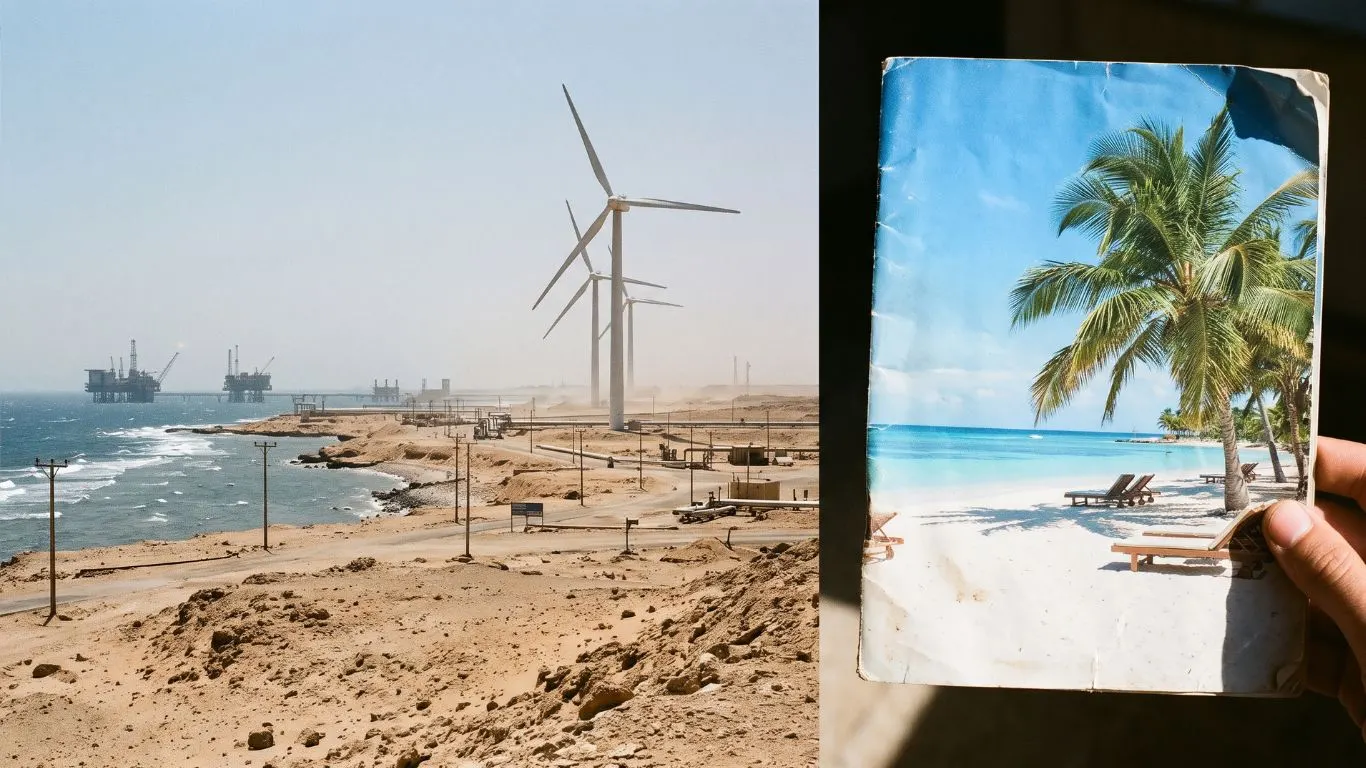
A practical look at Ras Ghareb as an emerging Red Sea property market, covering its oil and wind economy, worker housing demand, tourism limitations, thin resale market and the risks early investors should understand.
Ask ten people in a Hurghada café where Ras Ghareb is, and you'll get eleven answers, two shrugs and one man who insists it's "somewhere near the oil". He's not wrong. That's rather the point of this post. Every few months a name starts circulating in property groups as "the next Sahl Hasheesh", and Ras Ghareb has been on that list for a while. So let's do what the WhatsApp groups don't: look at what's actually there, what's coming, and what we simply don't know yet.
Spoiler, in the spirit of honesty: Ras Ghareb is not a resort town. Not yet, and possibly not ever. It is something more interesting for a patient investor, and something much less interesting for a holidaymaker. Let's unpack it.
Where it actually is (and why that matters)
Ras Ghareb sits on the western shore of the Gulf of Suez, the narrow arm of the Red Sea that runs up towards Suez. According to Wikipedia's entry on Ras Gharib, it is the northernmost district in the Red Sea Governorate and lies roughly 150 km north of Hurghada. The energy trade press places the town about 200 km south-east of Cairo, which is how MEED described its location in April 2025. The district is enormous, around 10,464 square kilometres, but most of it is desert and mountain. The same entry lists Zafarana as a village to the north and Wadi Dara as one to the south.
Here's why geography matters for your wallet. Hurghada, Sahl Hasheesh, El Gouna and Soma Bay all sit on the Red Sea proper, with coral reefs, calm turquoise water and an airport nearby. Ras Ghareb is on the Gulf of Suez, a different stretch of water with a very different character: more industrial, windier, and with far fewer tourists. If you've fallen in love with the snorkelling in Makadi Bay or the marina life in El Gouna, you will not find a copy of either here. Think of it as the cousin who works in energy and doesn't come to the beach parties.
A town built on oil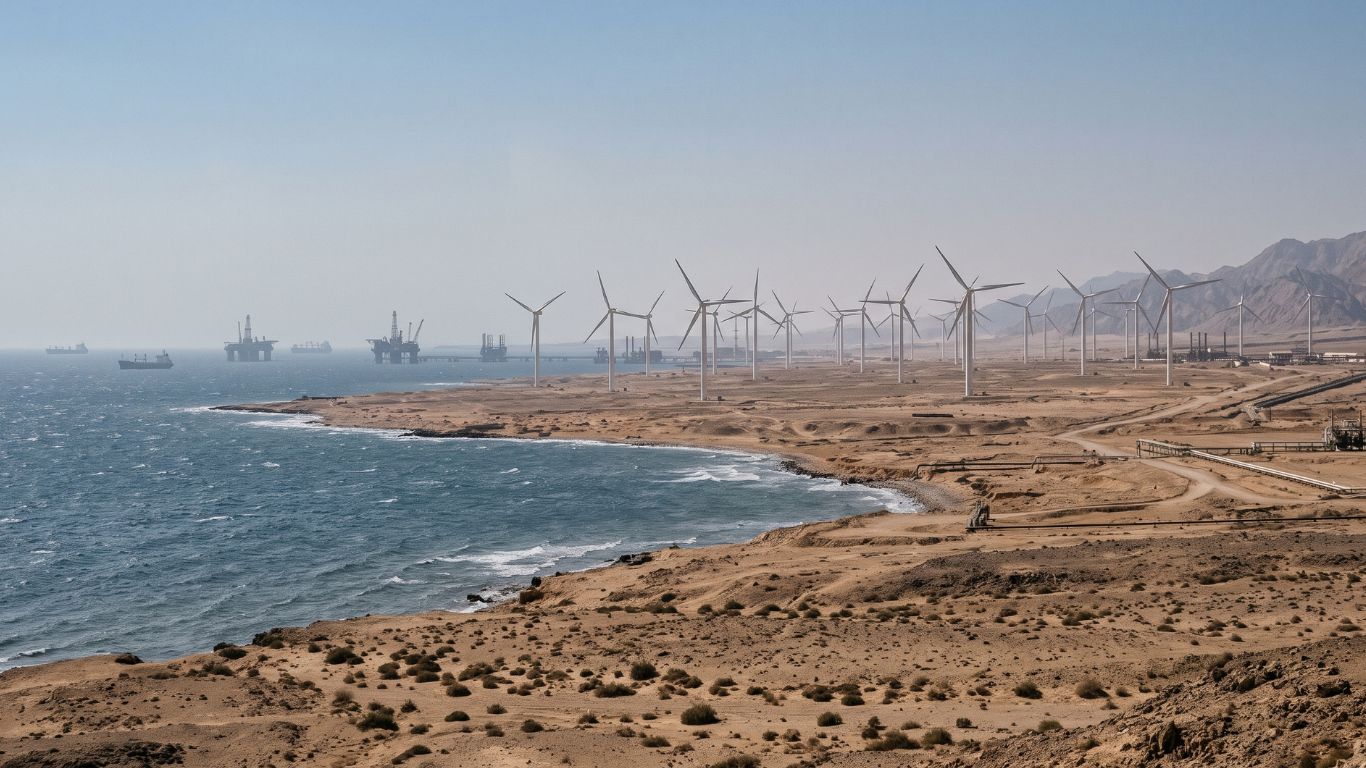
Ras Ghareb's story begins with petroleum. Wikipedia's account of the town says Anglo-Egyptian Oilfields, a Shell-linked company, drilled in the 1920s without success, struck oil in 1932, and began commercial shipments in August 1938, with output peaking in 1939 at around 5.1 million barrels. That is a lot of history for a place most holidaymakers have never heard of. The same entry reports the district hosts 78 petroleum companies and describes it as Egypt's "oil capital", with claims that it produces somewhere between 60% and 70% of the country's oil. Treat that percentage with a pinch of salt: the Red Sea Governorate page repeats a 70% figure but flags it as needing a citation, so it's a widely repeated claim rather than a hard statistic.
What is firmer is the size of the place. The same Wikipedia entry gives a 2023 population estimate of about 46,654, up from 32,369 in the 2006 census. Compare that with Hurghada, where Expat.com's guide puts the population at around 250,000. So Ras Ghareb is a small town, a fifth of Hurghada's size, with an economy that runs on shifts, rigs and quarries rather than sunbeds and all-inclusive wristbands.
The Clima-Med project page describes tourism as the second major sector after oil, resting on the beaches, the sea and historical sites, and notes that Bedouin communities are an important part of the population. It also lists the district's main environmental headaches: water scarcity, drought and extreme heat. That last trio deserves a pause. Anyone planning to live or rent out property here should ask very early where the water comes from.
The real story: wind
Now we get to why investors are paying attention. The Gulf of Suez is one of the windiest corridors in the region, and Ras Ghareb has become a hub for wind power. Two large projects are worth knowing about.
The first is the Red Sea Wind Energy project. According to MEED, in April 2025, its initial 500 MW phase, with 84 turbines, had started commercial operations six months ahead of schedule. The owners are Engie (35%), Orascom Construction (25%), Toyota Tsusho (20%) and Eurus Energy (20%), and a 150 MW expansion reached financial close in January 2025.
The second is the Suez Wind Energy project, a 1.1 GW development by ACWA Power (70%) and Hassan Allam Utilities' HAU Energy (30%). Enterprise reported in January 2025 that financial close was reached with a USD 703.6 million senior debt package from lenders including the EBRD, the African Development Bank and British International Investment. Phase one is at Ras Shukeir and phase two at Ras Ghareb, with full commercial operation scheduled for the second quarter of 2027. Wikipedia's Ras Gharib entry adds that the first turbine was installed on 30 December 2025.
Why should a property buyer care about turbines? Because big projects bring people. Construction crews, turbine technicians, grid engineers, security, catering and logistics all need somewhere to sleep. That is demand for rental flats, and it's a very different kind of demand from the holiday-let crowd. It's also our inference, not a number we can quote: none of the sources above say how many people will relocate or how many homes they will need. We'd love to give you a figure. We don't have one, and we won't invent it.
So, is it the next Sahl Hasheesh?
Let's compare honestly. Sahl Hasheesh was planned from the start as a resort bay: a long beach, a promenade, a marina, hotels and branded compounds. Ras Ghareb has a working economy first and holiday ambitions second. Those are opposite starting points, and neither is bad. Working towns can become pleasant places to live (look at how many oil cities around the world have lovely seafronts) but it normally takes decades, public investment and a clear plan.
Here is how we read the situation. The table is our own framing, not market data.
Question
Ras Ghareb today
Hurghada / Sahl Hasheesh
Main economy
Oil, quarrying, wind power
Tourism and property
Water
Gulf of Suez; pollution history
Open Red Sea, famous reefs
Tourist infrastructure
Limited; we found little verified information
Mature, airports, hotels, restaurants
Holiday-let potential
Unproven
Established
Rental demand driver
Energy-sector workers (our inference)
Holidaymakers, snowbirds, expats
Price data available
Very thin
Plenty of listings
One more thing the beach-lovers among you should know. Wikipedia's entry notes that repeated oil spills and marine pollution have affected parts of the coast and prompted environmental investigations. We are not saying every beach is affected, because we can't verify that. We are saying you should swim before you buy, ideally in more than one season, and ask locals where they take their own children.
What about the kitesurfing dream?
Every few weeks someone tells us Ras Ghareb will be "the new Soma Bay for kiters", because it's windy. Windy is necessary, but it isn't enough. Windfinder lists a forecast spot for Ras Gharib and names kitesurfing and windsurfing as uses of its data, but the page gives no wind statistics and no information about suitability, launch spots or schools. The Culture Trip's guide to the best kitesurfing spots in Egypt names Dahab, Ras Sudr, El Gouna, Safaga and Soma Bay, but not Ras Ghareb. So here's where we land: the wind is real, as the turbines suggest, but a kitesurfing scene with schools, rescue boats and a safe, flat-water beach is something we could not verify. If that is your reason for buying, visit in the windy season and see for yourself. If you want a ready-made kite lifestyle today, our guide to kite and dive lifestyles covers the places that already have it.
What about the property market?
This is where we need to be most careful. We went looking for prices, price per square metre and listing counts for Ras Ghareb and came back nearly empty-handed. The Bayut page for apartments for sale in Ras Gharib showed zero listings when we checked, while Property Finder shows 13,202 properties for sale across the Red Sea as a whole. We also saw a listing headline for an 80,400 square metre hotel or resort plot in Ras Gharib on a classifieds site, which suggests land is changing hands, but we haven't verified that listing or its price.
That tells you something in itself. A market with almost no public listings is a market with almost no resale liquidity. When you want to sell, there may be no queue of buyers. When you want to value your flat, there may be no comparable sales. That's the price of being early, and early-stage buyers should price it in. It's also why our platform, which currently has only a handful of listings in the area, treats Ras Ghareb as an emerging market rather than a mainstream one. For context, our own platform average net rental yield of 12.4% comes from established markets such as Hurghada and Sahl Hasheesh. It does not apply to Ras Ghareb and we wouldn't want you to assume it does. If you want to understand how to stress-test a yield claim, our guide on whether 12.4% is realistic walks you through it.
Who might it suit?
The patient land-banker. If you believe that a wind-powered, oil-rich district with new grid infrastructure will eventually need housing, services and a seafront, you might want a small, well-documented position. The key words are small and well-documented.
The landlord for workers. If the turbines bring a steady flow of technicians, a simple, durable furnished flat near the main roads may rent well on 6- or 12-month leases. That is a different business from a holiday let, and we have no data yet on rents, so run your own numbers locally.
Not the holidaymaker or retiree, today. If your dream is a sunny balcony, a reef at the end of the street and a decent selection of restaurants, Hurghada or Sahl Hasheesh will serve you far better. Hospitals, international schools and flights are all much closer to those places, and the heat and water points above still apply.
Seven questions before you put down a deposit
If you do get a tempting offer in Ras Ghareb, ask these first. They apply anywhere in Egypt, but they matter more where information is scarce.
First, is the land or unit registered, and can you see the title? The Egyptian Real Estate Registry's guide for foreign buyers notes the usual limits for foreigners (two properties, up to 4,000 square metres) and recommends bank transfers and receipts rather than cash. Second, who is the developer, and have they delivered anything before? Third, who supplies water and electricity, and what happens in a heatwave? Fourth, how far is the nearest hospital? Fifth, what is the road like, and how long does it really take to reach Hurghada, about 150 km away? Sixth, who will you sell to in five years? Seventh, has an independent lawyer read the contract?
If any answer is "don't worry about it", worry about it.
Our verdict
Ras Ghareb is a town to watch, not a town to rush. It has real assets: a long industrial history, serious wind investment from international lenders and developers, and a spot on the map that is closer to Cairo than Hurghada or Sahl Hasheesh. It also has real gaps: scarce price data, a coastline with a pollution history, limited tourist infrastructure, and a property market so quiet you can hear the turbines.
If we had to put it in a sentence: the wind farms are a reason to keep an eye on Ras Ghareb, and the lack of data is a reason to keep your wallet in your pocket until you've seen it with your own eyes.
Curious about where the Red Sea market is already working? Browse off-plan developments with clear payment plans, or explore apartments in Hurghada and villas in El Gouna. And if you own land or a unit in Ras Ghareb, list it with us for free and let's see who comes knocking.